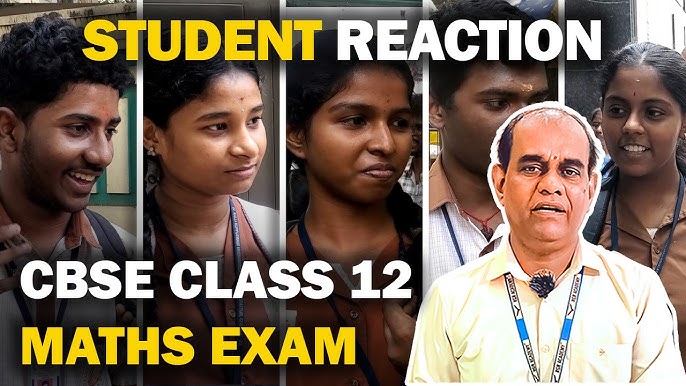
The Class 12 Mathematics board examination conducted by the Central Board of Secondary Education (CBSE) was successfully held across India today. Lakhs of students appeared for one of the most important papers in the Class 12 board examination, which plays a major role in determining college admissions and future academic opportunities.
Mathematics is considered one of the most challenging subjects in the board exams, especially for students who plan to pursue careers in engineering, economics, data science, or other fields related to Mathematics.
This year’s CBSE Class 12 Mathematics exam was conducted at thousands of examination centres across India under strict guidelines and security measures.
Exam Conducted Smoothly Across the Country
According to reports from multiple exam centres, the CBSE Class 12 Mathematics exam was conducted smoothly without any major issues.
Students arrived at examination centres early in the morning as per CBSE guidelines. The exam began at 10:30 AM and concluded at 1:30 PM, giving students a total of three hours to complete the paper.
CBSE officials ensured that all necessary arrangements were in place, including:
proper seating arrangements
strict invigilation
identity verification of candidates
safe distribution of question papers
Parents and teachers were also seen waiting outside many exam centres as students completed their exam.
Structure of the CBSE Class 12 Maths Question Paper
The CBSE Class 12 Mathematics paper follows a structured format designed to test students’ conceptual understanding and problem-solving skills.
The question paper is divided into five sections:
Section A – Multiple Choice Questions (MCQs)
This section includes objective questions that test basic concepts and formulas.
Section B – Short Answer Questions
Students must write brief solutions, typically requiring 2–3 steps.
Section C – Standard Problems
These questions require step-by-step calculations and explanations.
Section D – Long Answer Questions
More complex problems involving multiple concepts are included in this section.
Section E – Case Study Questions
This section tests students’ ability to apply mathematical concepts in real-life situations.
The paper usually carries 80 marks, while the remaining 20 marks are allotted for internal assessment conducted by schools.
Difficulty Level of the Paper
According to initial feedback from students and teachers, the overall difficulty level of the exam was moderate.
Some students reported that the paper included a balanced mix of easy, moderate, and challenging questions.
Easy Sections
Many students said that questions from the following chapters were relatively straightforward:
Relations and Functions
Matrices
Determinants
Probability
Students who practiced previous years’ question papers found these questions manageable.
Moderate Sections
Topics like Applications of Derivatives and Integrals required careful calculations and conceptual clarity.
Difficult Questions
Some students mentioned that a few questions from Vector Algebra and Three-Dimensional Geometry were slightly tricky and required more time to solve.
However, overall the paper was considered fair and based mostly on the official CBSE syllabus.
Student Reactions After the Exam
After the exam ended, many students shared their reactions outside exam centres.
Some students expressed relief that the paper was not as difficult as expected.
One student from Delhi said:
“Most of the questions were from the NCERT textbook. If you studied regularly, the paper was manageable.”
Another student from Mumbai mentioned that time management was important.
“The paper was lengthy but not extremely difficult. Students needed to manage time properly.”
However, some students found certain questions challenging, especially in the calculus section.
Despite minor difficulties, many students left the exam hall feeling confident about their performance.
Teacher and Expert Analysis
Teachers and education experts also analysed the question paper shortly after the exam.
According to several mathematics teachers, the paper was well balanced and concept-based.
Experts noted that CBSE continues to emphasize:
conceptual understanding
logical reasoning
real-life application of mathematics
Teachers also appreciated the inclusion of case-study questions, which test students’ analytical thinking skills.
Many educators believe that students who practiced NCERT problems and sample papers would find the exam manageable.
Importance of the Maths Exam for Students
The CBSE Class 12 Mathematics exam is extremely important for students who wish to pursue higher education in technical or analytical fields.
Subjects related to mathematics are essential for careers such as:
engineering
computer science
data science
economics
finance
Performance in the mathematics board exam can also affect eligibility for various competitive examinations.
Many universities consider board exam scores during admission processes, making this exam crucial for students’ academic futures.
Role of Preparation and Study Strategies
Students who performed well in the exam often credit their preparation strategies.
Successful preparation typically involves:
solving previous year question papers
practicing sample papers
revising formulas regularly
focusing on conceptual clarity
Many teachers recommend that students should first understand concepts from the NCERT textbook before attempting advanced questions.
Time management during the exam is also an important factor that influences performance.
Expected Result Date
After the completion of all board exams, the Central Board of Secondary Education will begin the process of evaluating answer sheets.
Based on previous trends, the CBSE Class 12 results are expected to be announced in May 2026.
Students will be able to check their results online through the official CBSE website by entering their:
roll number
school number
admit card details
The results will determine students’ eligibility for higher education programs in universities and colleges across India.
Tips for Students Waiting for Results
While waiting for results, students are advised to remain calm and focus on future academic plans.
Experts recommend that students should:
start researching college admission processes
explore different career options
prepare for entrance exams if required
Board exam results are important, but they are only one step in a student’s educational journey.
Students should continue working towards their long-term academic goals.
Conclusion
The CBSE Class 12 Mathematics exam 2026 was conducted successfully across India, with most students describing the paper as moderately difficult.
The exam tested students’ conceptual understanding and problem-solving abilities, reflecting the evolving approach of CBSE towards modern education.
As students now wait for the results, many are hopeful that their preparation and hard work will lead to good scores.
For thousands of students across the country, this exam represents an important milestone in their academic journey and the beginning of new opportunities in higher education.