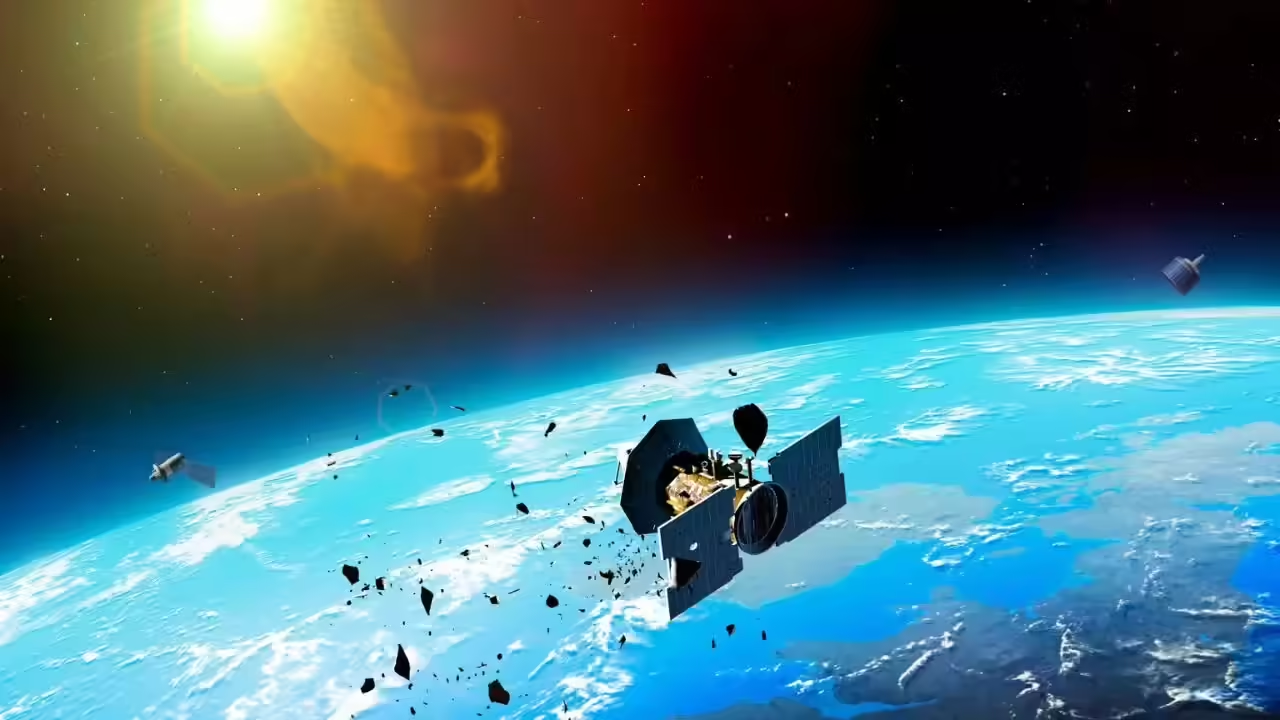
The possibility of satellites falling back to Earth has always fascinated and sometimes worried people around the world. Recently, reports about a NASA satellite crash or re-entry have sparked discussions among scientists, space agencies, and the general public.
Space missions often place satellites into orbit for communication, weather monitoring, navigation, and scientific research. However, satellites do not stay in space forever. Eventually, they return to Earth’s atmosphere due to gravitational forces and orbital decay.
Organizations like NASA constantly monitor satellites and space debris to ensure that re-entry events occur safely without posing significant risks to people or property.
Understanding why satellites fall and how agencies manage these events helps explain the science behind space missions and satellite lifecycles.
What Is a Satellite?
A satellite is an object placed into orbit around a planet or celestial body.
In modern space exploration, satellites play a crucial role in many aspects of everyday life.
Satellites are used for:
weather forecasting
GPS navigation
communication networks
scientific research
Earth observation
Many of these satellites are launched by organizations like NASA and other global space agencies.
Once in orbit, satellites travel at extremely high speeds while remaining balanced between Earth’s gravity and their forward motion.
Why Satellites Eventually Fall Back to Earth
Although satellites are designed to stay in orbit for years, they cannot remain there forever.
Several factors cause satellites to slowly lose altitude over time.
1. Atmospheric Drag
Even in space, there are small traces of Earth’s atmosphere.
These particles create friction that gradually slows down satellites.
2. Orbital Decay
As satellites lose speed due to atmospheric drag, their orbit becomes lower and lower.
Eventually, they begin to fall toward Earth.
3. End of Mission
Sometimes space agencies intentionally bring satellites down once their mission ends.
This process is known as controlled re-entry.
What Happens During Satellite Re-entry
When a satellite re-enters Earth’s atmosphere, it experiences extremely high temperatures due to friction with the air.
The object begins to heat up and break apart as it descends.
Most satellite components burn up completely before reaching the ground.
In rare cases, small fragments may survive and land in remote areas such as oceans or deserts.
Space agencies carefully calculate the path of falling satellites to minimize risks.
Famous NASA Satellite Re-entry Events
Over the decades, several satellites have returned to Earth after completing their missions.
One well-known example was the Upper Atmosphere Research Satellite (UARS).
This satellite was launched in 1991 to study Earth’s atmosphere.
After more than 20 years in orbit, it re-entered Earth’s atmosphere in 2011.
Although scientists predicted that some debris might survive the re-entry, no injuries or damage were reported.
Events like this demonstrate how carefully space agencies track and manage satellite re-entry.
Space Debris: A Growing Challenge
The issue of falling satellites is closely related to the broader problem of space debris.
Space debris refers to broken satellites, rocket parts, and other objects orbiting Earth.
According to experts, thousands of pieces of debris currently exist in orbit.
These objects travel at extremely high speeds and can pose risks to operational satellites and spacecraft.
Organizations like European Space Agency and NASA are working on strategies to reduce space debris.
How NASA Tracks Falling Satellites
NASA uses advanced tracking systems to monitor satellites and debris in orbit.
These systems include radar networks and space surveillance technology.
The data helps scientists predict when and where a satellite may re-enter Earth’s atmosphere.
Tracking allows authorities to issue warnings if necessary.
However, predicting the exact location of debris impact remains challenging due to changing atmospheric conditions.
Are Satellite Crashes Dangerous?
Many people worry about the possibility of satellites crashing into populated areas.
In reality, the risk is extremely low.
Earth’s surface is mostly covered by oceans and uninhabited land.
In addition, most satellite materials burn up completely during re-entry.
According to experts, the probability of a person being injured by falling space debris is extremely small.
Why Satellites Are Still Important
Despite the occasional satellite crash or re-entry event, satellites remain essential for modern society.
They support many technologies we rely on daily.
For example:
GPS navigation systems
satellite television
global internet communication
weather forecasting
Without satellites, many modern technologies would not function properly.
Future Solutions for Satellite Disposal
As space exploration continues to grow, scientists are developing new methods to safely dispose of satellites.
Some proposed solutions include:
Controlled Re-entry
Satellites can be guided toward specific ocean regions where debris will not cause harm.
Graveyard Orbits
Certain satellites are moved to higher orbits where they remain inactive but do not interfere with operational satellites.
Space Debris Removal
New technologies are being developed to capture and remove debris from orbit.
These solutions aim to keep Earth’s orbital environment safe for future missions.
Growing Number of Satellites in Space
The number of satellites in orbit has increased dramatically in recent years.
Private companies and space agencies are launching satellites for various purposes.
For example, companies such as SpaceX are deploying large satellite networks for global internet coverage.
While these systems provide valuable services, they also increase the need for effective space traffic management.
International Cooperation in Space Safety
Managing satellite crashes and space debris requires global cooperation.
Space agencies from different countries share tracking data and coordinate efforts to ensure safety.
International guidelines help regulate how satellites are launched, operated, and eventually removed from orbit.
Such cooperation is essential for maintaining a sustainable space environment.
Public Reaction to Satellite Re-entry News
Whenever news about a falling satellite appears, it often attracts global attention.
People are naturally curious about space events and the possibility of objects returning to Earth.
However, experts emphasize that satellite re-entry is a normal part of space operations.
With modern tracking systems and careful planning, the risks are minimal.
Conclusion
Satellite crashes or re-entry events are a natural part of the lifecycle of space missions.
Organizations like NASA carefully monitor satellites and ensure that their return to Earth occurs safely.
While falling satellites may sound alarming, the reality is that most debris burns up in the atmosphere and rarely poses any danger.
As space exploration continues to expand, new technologies and international cooperation will play a key role in managing satellites and protecting Earth’s orbital environment.
The growing importance of satellites in communication, navigation, and science ensures that they will remain a vital part of modern technology for many years to come.