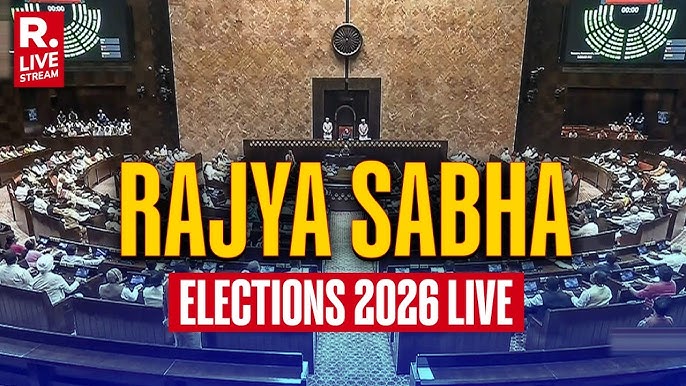
The Rajya Sabha Election 2026 has emerged as one of the most important political developments in India this year. With multiple seats up for grabs across several states, the election is expected to play a crucial role in shaping the legislative balance in Parliament.
The Rajya Sabha, also known as the Council of States, is a key pillar of India’s democratic system. Unlike the Lok Sabha, its members are not directly elected by the public but are chosen through an indirect electoral process.
As political parties gear up for the election, intense strategizing, alliances, and negotiations are already underway.
What Is Rajya Sabha and Why It Matters
The Rajya Sabha is the upper house of the Parliament of India.
It plays a vital role in:
Reviewing legislation passed by the Lok Sabha
Representing states and union territories
Acting as a stabilizing force in Indian democracy
Members of the Rajya Sabha serve a term of six years, with one-third of the members retiring every two years.
This makes the Rajya Sabha a continuous house, unlike the Lok Sabha which is dissolved every five years.
Rajya Sabha Election 2026: Key Highlights
The 2026 Rajya Sabha elections are being held to fill seats of members whose terms are ending.
Key Points:
Elections are conducted across multiple states
Members are elected by MLAs (Members of Legislative Assemblies)
Voting follows a proportional representation system
Political parties aim to strengthen their presence in the upper house
The outcome of these elections will directly impact the ability of the ruling government to pass legislation smoothly.
Election Schedule and Process
The elections are conducted by the Election Commission of India.
Typical Election Process:
Notification Issued
The Election Commission announces the election schedule.Nomination Filing
Candidates file their nominations.Scrutiny and Withdrawal
Nominations are verified, and candidates can withdraw if needed.Voting Day
MLAs cast their votes.Counting and Results
Votes are counted, and winners are declared.
How Rajya Sabha Elections Work
Rajya Sabha elections follow a unique system called proportional representation with a single transferable vote (STV).
Key Features:
MLAs vote instead of the general public
Voters rank candidates based on preference
Candidates must secure a minimum number of votes (quota) to win
This system ensures fair representation of different political parties.
Major Political Parties in the Fray
Several national and regional parties are contesting in the Rajya Sabha Election 2026.
Key Parties Include:
Bharatiya Janata Party (BJP)
Indian National Congress (INC)
Regional parties from states like Tamil Nadu, West Bengal, and Maharashtra
Each party is trying to maximize its seat share to strengthen its position in Parliament.
State-Wise Political Battle
The outcome of Rajya Sabha elections often depends on the strength of parties in state assemblies.
Key Battleground States:
Uttar Pradesh
Maharashtra
West Bengal
Tamil Nadu
Karnataka
In these states, even a small shift in numbers can impact the final results.
Importance for the Central Government
For the ruling party, gaining a majority in the Rajya Sabha is crucial.
Why?
Because even if a bill is passed in the Lok Sabha, it must also be approved by the Rajya Sabha.
A lack of majority in the upper house can delay or block key legislation.
Role of Alliances and Cross-Voting
Rajya Sabha elections often see:
Strategic alliances between parties
Independent candidates influencing outcomes
Instances of cross-voting
Cross-voting occurs when MLAs vote against their party line.
This can significantly impact results, especially in closely contested seats.
Recent Trends in Rajya Sabha Elections
In recent years, Rajya Sabha elections have become more competitive.
Key trends include:
Increased political bargaining
Rise of regional parties
Strategic candidate selection
These trends are expected to continue in 2026 as well.
Key Candidates to Watch
Although final candidate lists vary by state, political parties typically nominate:
Senior leaders
Experienced politicians
Subject matter experts
Sometimes, celebrities and professionals are also nominated to bring diverse perspectives to Parliament.
Impact on Indian Politics
The Rajya Sabha Election 2026 is not just about numbers — it has broader implications.
It affects:
Legislative decision-making
Policy implementation
Political stability
A stronger presence in the Rajya Sabha allows the ruling party to push reforms more effectively.
Public Interest and Media Coverage
Although Rajya Sabha elections are indirect, they attract significant media attention.
News channels and digital platforms closely track:
Candidate announcements
Voting patterns
Final results
This helps the public stay informed about political developments.
Challenges and Controversies
Rajya Sabha elections sometimes face challenges such as:
Allegations of cross-voting
Political pressure on MLAs
Legal disputes over nominations
Despite these challenges, the Election Commission ensures that the process remains transparent and fair.
What to Expect in 2026
Political experts predict that the Rajya Sabha Election 2026 will be:
Highly competitive
Strategically intense
Crucial for future policymaking
Both national and regional parties are expected to play significant roles.
Conclusion
The Rajya Sabha Election 2026 is a key event in India’s political calendar.
With major parties competing for influence in the Rajya Sabha, the outcome will shape the future of legislation and governance in the country.
As the elections unfold, all eyes will be on the results and their impact on the balance of power in the Parliament of India.
For citizens, understanding the significance of these elections is essential to appreciating how India’s democratic system functions.